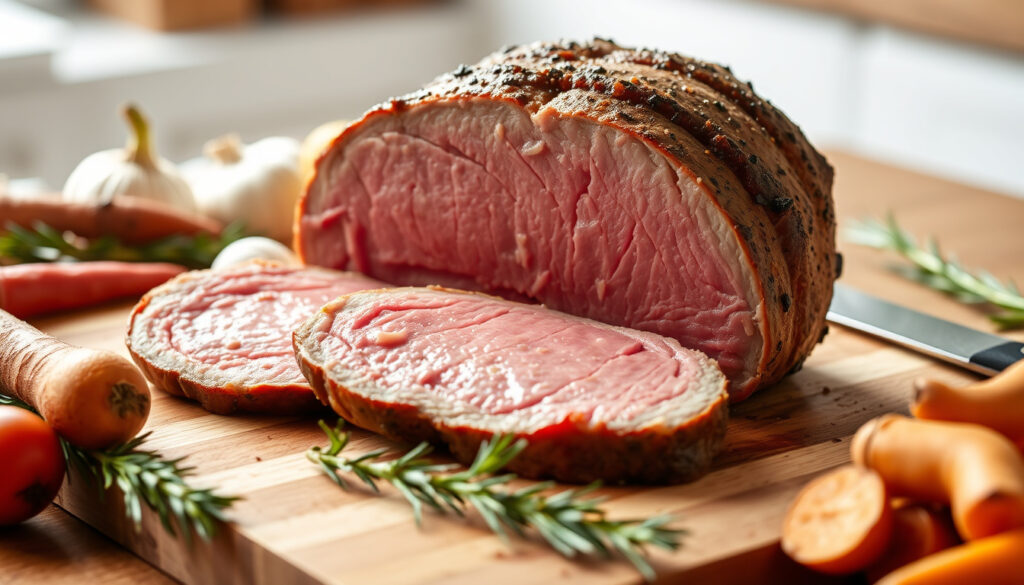
Eye of Round Roast: Best Cooking Methods for Tender Results
Most people see eye of round at the butcher counter and keep walking—it’s lean, it’s budget-friendly, and it has a reputation for turning out tough. But here’s the secret: with the right technique, this cut punches way above its weight class. Think of it as the poor man’s ribeye, if you know how to treat it.
Best internal temp: 125°F · Rest time: 20 minutes minimum · Ideal doneness: rare to medium rare · Slice style: thin slices · Cut type: lean roast
Quick snapshot
- Exact price variations by region
- Availability differences at major retailers
- Season 4–6 hours or overnight ahead (ChefAlli)
- Rest 30–60 minutes at room temp before cooking (Valerie’s Kitchen)
- Slice against grain at ¼-inch thickness (Valerie’s Kitchen)
- Final temp reaches 130–135°F after resting (Valerie’s Kitchen)
| Attribute | Details |
|---|---|
| Cut description | Lean roast from round primal |
| Best temp | 125°F internal |
| Nickname | Poor man’s steak |
| Serving style | Thin slices, rare-medium rare |
What is the best cooking method for eye of round roast?
Two dominant approaches emerge from professional recipes: the high-heat sear followed by low oven roasting, or the low-and-slow moist heat method in a slow cooker or Dutch oven. Both can deliver tender results—but they produce different textures and flavor profiles.
Oven roasting basics
The oven method works in two phases. Start hot to build a crust, then finish low to gently tenderize the lean muscle fibers. A typical sequence runs 450–500°F for 15–25 minutes to brown the exterior, then 225–325°F until you hit 125°F at the center (Life With The Crust Cut Off). One recipe from ChefAlli recommends a specific timeline: 450°F for 20–25 minutes, then reduce to 325°F and cook to an internal temperature of 125°F (ChefAlli). The key is watching closely near the end—the temperature can spike fast.
“Watch it closely because the temperature can rise quickly towards the end of the cooking time.”
— Valerie’s Kitchen, Valerie’s Kitchen
Slow cooker approach
For a hands-off day, the slow cooker delivers fork-tender results through moist heat. Set it to low for 7–8 hours or high for 4–5 hours until the roast reaches pull temperature (Kitchen Parade). Some recipes push the low setting up to 8 hours maximum for larger cuts (Craft Beering). Always sear the roast first if you want deeper flavor—the Maillard reaction on the surface makes a noticeable difference.
Searing and resting technique
Browning before braising matters more than most home cooks realize. According to Craft Beering, “Browning works best when the beef is at room temperature and its surface is dry” (Craft Beering). Pat the roast dry and let it temper for 30–60 minutes before searing. After cooking, rest the roast tented with foil for 15–20 minutes—this allows carryover heat to finish the job and lets the juices redistribute (Valerie’s Kitchen).
“Browning works best when the beef is at room temperature and its surface is dry.”
— Craft Beering, Craft Beering
Oven roasting at 200°F avoids the mushiness that slow cookers sometimes produce. Kitchen Parade notes that at a consistent low temperature, “the meat safely cooks without undercooking, burning, or turning to mush” (Kitchen Parade).
Is eye of round roast a good cut?
The honest answer depends on what you’re comparing it to and how you cook it. Eye of round sits in the round primal—the rear leg of the cow, which does heavy work. That means more muscle, less marbling, and a reputation for toughness if mishandled. But handled correctly? It earns its nickname as a “poor man’s steak” for a reason.
Pros as budget-friendly option
Eye of round typically costs less than chuck or ribeye cuts, making it attractive for feeding crowds without breaking the budget. At roughly 3–5 pounds, a single roast yields multiple meals. The cut has no waste—it’s a uniform cylinder that’s easy to carve once cooked. Seasoning absorbs evenly across the surface, and because it’s lean, it pairs well with bold marinades or dry rubs.
Cons of lean texture
The lack of intramuscular fat means this cut dries out faster than marbled roasts. Overcooking makes it chewier than a well-done ribeye—and that’s saying something. Life With The Crust Cut Off puts it plainly: “This cut is best served medium-rare to medium. Overcooking can make it tough” (Life With The Crust Cut Off). The lean profile also means less flavor saturation from rendered fat, so you compensate with sauces or proper seasoning.
“This cut is best served medium-rare to medium. Overcooking can make it tough.”
— Life With The Crust Cut Off, Life With The Crust Cut Off
Comparison to ribeye
Ribeye delivers marbling that self-bastes during cooking; eye of round requires active technique to retain moisture. Where ribeye forgives minor temperature overshoots, eye of round punishes them. The tradeoff is real: ribeye costs 2–3× more per pound, while eye of round rewards the cook who pays attention to temp and timing.
If you’re hosting a dinner party and want guaranteed tenderness without babysitting the oven, chuck roast or brisket outperform eye of round. But for weeknight dinners where you want steak-like results from a grocery-store cut, eye of round delivers—provided you respect its limitations.
What are the common mistakes when cooking eye of round?
The gap between a tough, dry roast and a tender, impressive centerpiece usually comes down to five predictable errors. Most stem from treating eye of round like a more forgiving cut.
Overcooking pitfalls
This is the big one. Eye of round offers no margin for error—push past medium-rare and you enter dry territory fast. Valerie’s Kitchen warns: “Watch it closely because the temperature can rise quickly towards the end of the cooking time” (Valerie’s Kitchen). An instant-read thermometer isn’t optional here; it’s essential. Pull at 125°F and let carryover heat finish the job to 130–135°F.
Skipping the sear
Without the initial high-heat phase, eye of round tastes flat. The sear builds flavor compounds through the Maillard reaction that you simply can’t replicate in a slow cooker alone. Even a quick 5–7 minutes per side in a hot cast-iron skillet before the low-oven phase makes a measurable difference (Alderspring Ranch).
Thick slicing errors
Even a perfectly cooked eye of round turns chewy if you slice it wrong. Cut against the grain at ¼-inch thickness—any thicker and you override the tenderness you’ve built through cooking (Valerie’s Kitchen). A sharp carving knife matters here; a dull blade crushes the fibers rather than separating them cleanly.
Skipping the rest
Cutting into a hot roast immediately sends juices cascading onto the cutting board instead of into your meat. Rest 15–20 minutes tented loosely with foil. This isn’t passive waiting—it’s active moisture retention. The proteins need time to relax and reabsorb liquid that cooking drove to the center.
Cold roast in a hot oven creates uneven cooking: a cold center with a overbrowned exterior. Always rest the seasoned roast at room temperature for 30–60 minutes before it hits the oven or slow cooker.
How long do you cook eye of the round?
Forget the clock—cook to temperature, not time. That said, you need a starting point, and that starting point depends on your method and the roast’s weight.
Cooking time by weight
For a 3–4 pound roast using the high-sear-low-oven method, expect 45–75 minutes total after the initial sear phase. A 2-pound roast cooks faster—closer to 40–55 minutes total. Slow cooker times run longer: 7–8 hours on low or 4–5 hours on high for a 3–4 pound cut (Craft Beering). Kitchen Parade notes that oven slow-cooking at 200°F typically takes 4–8 hours depending on size (Kitchen Parade).
Oven vs slow cooker times
The oven gives you more precise control. The slow cooker gives you set-it-and-forget-it convenience. Neither is objectively better—they serve different priorities. Oven roasting preserves more surface texture; slow cooking yields deeper internal tenderness and works beautifully with braising liquids and vegetables.
2 lb roast specifics
A smaller roast heats faster and risks overshooting target temp more quickly. At 450°F initial heat for 15 minutes, then 300°F, a 2-pound eye of round might hit 125°F in as little as 35–45 minutes total (Valerie’s Kitchen). Check temperature every 10 minutes after the first 30 minutes to avoid overshooting.
How to cook eye of round so it is tender?
Tenderness in eye of round comes from three sources: temperature precision, moisture management, and strategic slicing. Get all three right and this budget cut rivals more expensive steaks.
Marinating tips
Seasoning 4–6 hours ahead—or overnight—makes a measurable difference. Salt penetrates the muscle fibers and begins breaking down proteins before cooking even starts. ChefAlli recommends this approach, noting that early seasoning “for best results” (ChefAlli). A simple salt-and-pepper rub works, but acidic marinades (vinegar, citrus) can over-tenderize the surface if left too long—2–4 hours max for acid marinades.
Low and slow methods
For maximum tenderness, the slow cooker or Dutch oven excels. Braising in liquid at 325°F for 3–5 hours breaks down collagen and transforms the lean muscle into something yielding (Craft Beering). The trade-off is a different texture than oven roasting—you get fall-apart tenderness rather than sliceable medium-rare.
Post-cook resting
Resting is non-negotiable. After oven roasting to 125°F, tent the roast loosely and wait 20 minutes minimum. Residual heat carries the internal temperature to 130–135°F—medium-rare territory (ChefAlli). Slice against the grain at ¼-inch thickness immediately after resting. The moment between slicing and serving should be as short as possible.
Upsides
- Budget-friendly price per pound
- Minimal waste, easy carving
- Versatile for multiple cooking methods
- Absorbs seasoning well
- Impressive results reward attention to detail
Downsides
- Forgiving only up to a point—overcooking ruins it
- Requires temperature monitoring
- Thin slicing essential adds prep time
- Less flavor than marbled cuts without extras
- Not ideal for well-done preferences
Related reading: Recette de Pain de Viande · How Long Is Cooked Chicken Good For in the Fridge?
This budget-friendly lean cut responds best to precise methods, as explored in the eye of round cooking guide that emphasizes marinating and low-heat roasting for juicy results.
Frequently asked questions
What cut is a poor man’s steak?
Eye of round roast carries this nickname because it mimics steak texture and flavor at a fraction of the cost. With proper technique—high sear, low oven, precise temp, and thin slicing—it delivers steak-like results from a grocery-store budget cut.
Eye of round roast cooking time?
In the oven: 450–500°F for 15–25 minutes, then 225–325°F until 125°F internal (roughly 40–75 minutes total depending on size). In the slow cooker: 7–8 hours on low or 4–5 hours on high. Always use a thermometer rather than relying on time alone.
Eye of round roast slow cooker?
Yes—sear first for flavor, then add liquid (broth, wine, or sauce), set on low for 7–8 hours or high for 4–5 hours. The roast is done when a fork slides in with no resistance. Some cooks prefer oven slow-cooking at 200°F for better temperature control than most slow cookers provide.
Eye of round roast in oven?
Season 4–6 hours ahead. Rest at room temperature 30–60 minutes. Sear at 450–500°F for 15–25 minutes. Reduce to 225–325°F and cook to 125°F internal. Rest 15–20 minutes tented with foil. Slice against grain at ¼-inch thickness.
How to slow cook an eye of round roast?
Pat the roast dry and sear on all sides in a hot skillet. Place in slow cooker with braising liquid (½–1 cup). Cook on low 7–8 hours or high 4–5 hours until fork-tender. Rest 10–15 minutes before slicing. For best results, avoid opening the lid during cooking to maintain consistent temperature.
Eye of Round Roast price?
Prices vary by region and retailer, but eye of round typically runs $4–7 per pound—significantly less than ribeye ($12–20/lb) or even chuck roast ($5–9/lb). Watch for sales at warehouse clubs or major grocery chains, where you might find it at the lower end of that range.
Eye of Round Roast for sale?
Most major grocery chains stock eye of round in the meat case or freezer section. It appears regularly at Walmart, Kroger, Safeway, and Costco. If your local store doesn’t carry it consistently, ask the butcher to order it—it’s a standard wholesale cut that suppliers keep in stock.
For home cooks tired of paying ribeye prices for special dinners, eye of round offers a compelling alternative—but only if you’re willing to pay attention. The difference between a disappointing chew and a memorable meal often comes down to a thermometer reading and 20 minutes of resting time. Treat this cut like it costs three times as much, and it will perform like it does.
More related posts
 Jordan 4 Red Thunder – Release Date Price Resale Guide
 Barry and Honey Sherman – Unsolved Murders Timeline
 The Wiggles The Twelve Days of Christmas Lyrics – Full Lyrics and Album Guide
 Gold Price Per Gram Canada – Live CAD Rates Today
 How to Stop Hiccups – Proven Home Remedies That Work
 How Long Is Cooked Chicken Good For in the Fridge?
 John Edward Thomas Moynahan: Tom Brady’s Son Jack Bio