Hollow Water First Nation: Location, News & Stabbings
When a mass stabbing unfolded at Hollow Water First Nation on the morning of 4 September 2025, it sent shockwaves through a community already navigating systemic challenges. The incident—which left one person dead and eight others injured—has reignited difficult conversations about public safety, bail systems, and the resources available to First Nations communities in Manitoba.
Location: East side of Lake Winnipeg, 75 km north of Pine Falls · Band Number: 263 · Official Name: Hollow Water · Address: PO BOX 2561, Wanipigow, MB R0E 2E0 · Phone: (204) 363-7278
Quick snapshot
- One fatality (Marina Simard, 18) and eight injured victims aged 18-60 (Wikipedia)
- Perpetrator Tyrone Simard, 26, was out on bail from charges laid on 8 June 2025 (Wikipedia)
- Incident occurred on third anniversary of 2022 Saskatchewan stabbings (Wikipedia)
- Chief Larry Barker publicly asked community members to pray and support one another (Halifax CityNews)
- Specific motive for the attack has not been released by authorities
- Detailed condition updates on injured victims and RCMP officer beyond initial reports
- Prior sexual assault charges details from 2017 remain limited in public record
- Full list of all victims’ identities and their relations to the perpetrator
- Three victims remained hospitalized as of 8 September 2025; four had been discharged (UBCIC)
- UBCIC called for national resources to address violence in First Nations (UBCIC)
- Manitoba Premier Wab Kinew offered ongoing support to Hollow Water leadership (UBCIC)
- Long-term community healing initiatives yet to be announced (UBCIC)
| Field | Details |
|---|---|
| Band Name | Hollow Water First Nation |
| Ojibwe Name | Waanibiigaaw or Wanipigow |
| Nation | Anishinaabe (Ojibwa) |
| Band Number | 263 |
| Website | hollowwater.ca |
What happened at Hollow Water First Nation?
On the morning of 4 September 2025, a mass stabbing incident unfolded at Hollow Water First Nation, a community of approximately 1,000 residents located on the eastern shore of Lake Winnipeg in Manitoba. The attack began around 3:00 a.m. when 26-year-old Tyrone Simard approached 60-year-old Michael Raven and asked to borrow his quad. When Raven refused, Simard broke into his home about 15 minutes later and stabbed Raven and his girlfriend.
2025 stabbings details
The violence escalated quickly. RCMP received the first report from a First Nation security officer at 3:45 a.m. A second call came in at 5:53 a.m. reporting a possible stabbing, prompting officers from multiple detachments to respond. By that point, the perpetrator had already fled south towards Black River in a stolen vehicle. Around 6:50 a.m., Simard collided with an RCMP cruiser and was killed.
The sole fatality was 18-year-old Marina Simard, the perpetrator’s sister. Eight other victims—aged 18 to 60—were injured, including the perpetrator’s aunt Marcelina Bushie. Six victims were transported by ambulance, with two airlifted by STARS air ambulance. By 8 September 2025, three victims remained hospitalized while four had been discharged.
“What happened early this morning is a tragedy for the community of Hollow Water First Nation, and all of Manitoba.”
— RCMP Assistant Commissioner Scott McMurchy (Wikipedia)
The attack occurred on the third anniversary of the 2022 Saskatchewan stabbings at James Smith Cree Nation, where 12 people were killed and 17 injured. RCMP described the timing as a coincidence, but the parallel has deepened grief across Indigenous communities already grappling with cycles of violence.
Where is Hollow Water First Nation?
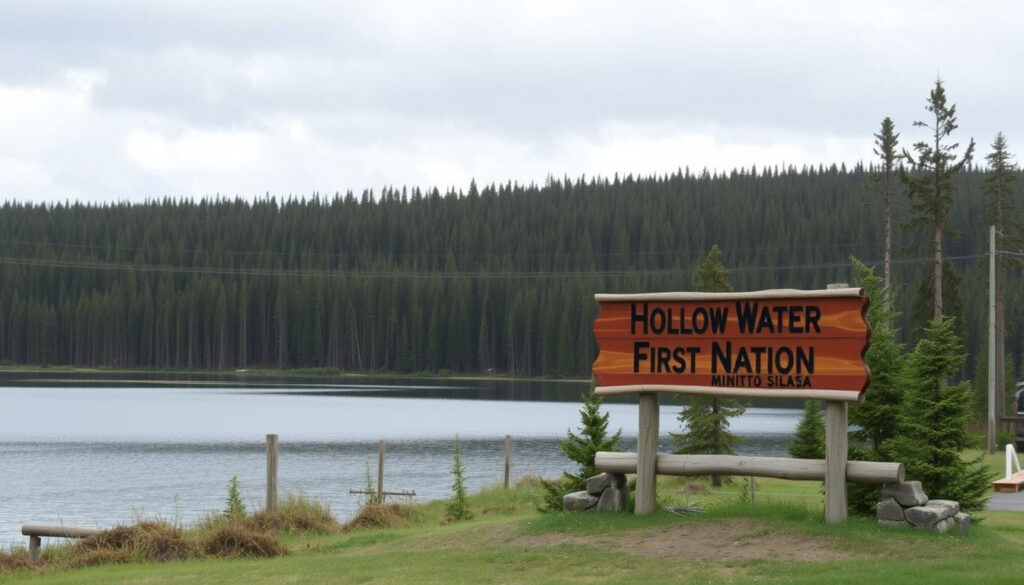
Hollow Water First Nation sits on the east side of Lake Winnipeg, approximately 200 kilometres northeast of Winnipeg and about 75 kilometres north of the town of Pine Falls. The community, also known by its Ojibwe name Waanibiigaaw or Wanipigow, is situated within Treaty 5 territory.
Location on Lake Winnipeg
The community occupies a stretch of shoreline along the eastern edge of Lake Winnipeg, one of Canada’s largest lakes. Its remote location—while picturesque—presents ongoing challenges for emergency services response times and access to specialized healthcare. The nearest major hospital capable of handling mass casualty incidents is in Winnipeg, which means air ambulance services like STARS play a critical role in medical emergencies.
Map references
Hollow Water First Nation is accessible primarily by road via Provincial Trunk Highway 59, which runs north-south along the eastern side of Lake Winnipeg. The community’s isolation from urban centres has been cited in discussions about resource allocation and emergency preparedness for First Nations communities in Manitoba.
Who is the chief of Hollow Water First Nation?
Chief Larry Barker leads Hollow Water First Nation and has served in that capacity during this crisis. His emotional response at a news conference following the 4 September 2025 stabbings reflected the personal toll this violence has taken on community leadership.
Current leadership
Chief Barker addressed the community directly in the aftermath, asking residents to pray and support one another. He noted that he personally knew many of the victims, underscoring the close-knit nature of the community of approximately 1,000 people.
“I ask the community to pray and support one another out there. And my prayers go to the people that are in the hospital right now recovering.”
— Chief Larry Barker, Hollow Water First Nation (Halifax CityNews)
The chief and council have been working closely with RCMP investigators and have expressed condolences to all affected families. Chief Barker has called for community unity during the healing process.
What treaty is Hollow Water?
Hollow Water First Nation operates within Treaty 5 territory, one of the numbered treaties signed between the Crown and Indigenous nations in Western Canada during the 1870s. Treaty 5 covers portions of present-day Manitoba and Saskatchewan.
Treaty affiliations
The community is affiliated with the Southern Chiefs’ Organization Inc., a tribal council representing several Anishinaabe (Ojibwa) First Nations in southern Manitoba. The Southern Chiefs’ Organization advocates for the rights and wellbeing of its member communities, including Hollow Water.
Treaty rights encompass land, resources, and self-governance arrangements, though the specific implementation varies by community. Hollow Water’s treaty territory includes the lands surrounding Lake Winnipeg’s eastern shore.
Hollow Water First Nation community overview
Hollow Water First Nation is home to approximately 1,000 residents, most of whom belong to the Anishinaabe (Ojibwa) nation. The community has its own band office located in Wanipigow, which serves as the administrative centre for local governance and services.
Band office
The Hollow Water First Nation Band Office can be reached at PO Box 2561, Wanipigow, MB R0E 2E0, or by phone at (204) 363-7278. The band office coordinates essential services including housing, education, health, and social programs. The community also falls under the jurisdiction of Southeast Child & Family Services for child welfare matters.
Population
With a population hovering around 1,000 residents, Hollow Water is a small First Nation community by Canadian standards. The community has historically faced challenges common to many remote First Nations, including limited access to healthcare, educational resources, and economic opportunities.
News and photos
The September 2025 stabbings brought unprecedented national attention to Hollow Water First Nation. Media coverage from outlets including APTN News, Winnipeg Free Press, and CityNews documented the incident and its aftermath. The community’s official website (hollowwater.ca) serves as a resource for residents and those seeking information about programs and services.
The influx of media attention following the September 2025 tragedy has created both challenges and opportunities for Hollow Water. While the coverage has focused on violence and trauma, it has also highlighted the resilience of the community and raised questions about systemic support for First Nations across Canada.
Timeline of the 4 September 2025 incident
The following timeline reconstructs the sequence of events on the morning of 4 September 2025 based on police reports and media accounts:
| Time | Event |
|---|---|
| ~3:00 a.m. | Tyrone Simard approaches Michael Raven, 60, asks to borrow his quad; Raven refuses |
| 3:15 a.m. | Simard breaks into Raven’s home; stabs Raven and his girlfriend |
| 3:45 a.m. | First Nation security officer reports assault to RCMP |
| 5:53 a.m. | RCMP receives call about possible stabbing; multiple detachments respond |
| ~6:50 a.m. | Simard fleeing south in stolen vehicle collides with RCMP cruiser; killed |
| 9:00 a.m.+ | RCMP hold news conference; Chief Larry Barker addresses community |
| 8 September | Three victims still hospitalized; four discharged from hospital |
The implication: the ~3-hour window between the first assault and the RCMP response highlights the geographic challenges of policing remote First Nations communities where officer availability and travel distances create response delays.
Confirmed facts and open questions
The verified facts from the 4 September 2025 incident are substantial, having been reported across multiple outlets including Wikipedia, CityNews, Winnipeg Free Press, APTN News, and CJME. However, several questions remain unanswered.
Confirmed facts
- Location east of Lake Winnipeg, ~200 km northeast of Winnipeg
- Band number 263
- One fatality (Marina Simard, 18) and eight injured
- Perpetrator Tyrone Simard was 26 years old and out on bail
- Incident occurred on Treaty 5 territory
- Chief Larry Barker leads the community
- Incident on third anniversary of 2022 Saskatchewan stabbings
What’s unclear
- Specific motive for the attack
- Current medical condition of hospitalized victims
- Details of the 2017 sexual assault charges
- Full identities and relations of all victims
- Long-term community healing initiatives
Official responses and reactions
The mass stabbing prompted responses from Indigenous leaders and government officials at multiple levels.
“To the leadership and to the community members of Hollow Water, our hearts are with you. Our hearts feel very heavy, and we will be there to support you.”
— Wab Kinew, Manitoba Premier (Halifax CityNews)
Premier Kinew, Manitoba’s first First Nations premier, offered immediate support to Hollow Water leadership. Federal ministers Rebecca Alty and Mandy Gull-Masty also expressed heartbreak and committed government support. The incident occurred during the AFN 2025 Annual General Assembly in Winnipeg, bringing Indigenous leadership from across Canada into immediate dialogue about the tragedy.
“We must put an end to the violence impacting our communities. It is time for governments to listen, to provide real resources.”
— Don Tom, UBCIC Vice-President (UBCIC)
The Union of British Columbia Indian Chiefs (UBCIC) shared condolences and used the moment to call for systemic change. RCMP described the community as tight-knit and loving, with officers noting the devastating impact on residents who knew the victims personally.
The intersection of the perpetrator’s bail status and the violence raises questions about Canada’s bail system and whether adequate supports exist for individuals with criminal histories released into remote communities. RCMP’s description of Simard as “a man on a rampage” suggests the attack was indiscriminate once it began.
Broader context: violence in Indigenous communities
The Hollow Water tragedy exists within a painful broader pattern. The attack’s timing on the third anniversary of the 2022 Saskatchewan stabbings at James Smith Cree Nation—which left 12 dead and 17 injured—has not gone unnoticed. While RCMP called the date coincidence, Indigenous advocates point to systemic factors that create cycles of violence.
First Nations communities across Canada face disproportionate rates of violence, substance abuse, and limited access to mental health services. Remote locations compound these challenges, as emergency response times can be measured in hours rather than minutes, and specialized services require travel to urban centres.
For Hollow Water, the path forward will require both immediate support for victims and families and longer-term investment in community wellness programs. The incident has also brought attention to bail system adequacy—a question that extends well beyond this community.
Related reading: National Sport of Canada
youtube.com, montreal.citynews.ca, winnipegfreepress.com, aptnnews.ca, youtube.com
Frequently asked questions
What recent news affects Hollow Water First Nation?
The most significant recent event is the 4 September 2025 mass stabbing that left one person dead and eight injured. The incident is under investigation by RCMP, and community leadership has been working with police while offering support to affected families.
How to contact Hollow Water First Nation Band Office?
The Band Office is located at PO Box 2561, Wanipigow, MB R0E 2E0. You can reach them by phone at (204) 363-7278. Their official website is hollowwater.ca.
What is the cultural significance of Hollow Water First Nation?
Hollow Water First Nation is an Anishinaabe (Ojibwa) community located on Treaty 5 territory along the eastern shore of Lake Winnipeg. The community of approximately 1,000 residents maintains traditional connections to the land and waters of the region. The community is also known by its Ojibwe name, Waanibiigaaw or Wanipigow.
What environmental issues face Hollow Water First Nation?
Like many First Nations in Manitoba, Hollow Water faces environmental concerns related to water quality, land stewardship, and resource development in surrounding areas. The community’s location on Lake Winnipeg places it at the intersection of traditional territory and industrial activity in the region.
What child and family services are in Hollow Water First Nation?
Hollow Water First Nation falls under the jurisdiction of Southeast Child & Family Services for child welfare matters. This agency coordinates child protection services, family support programs, and related social services for community members.
More related posts
 Valentines for Vets Returned – Why VA Returned the Cards
 Movies to Watch 2025: Top Picks from Critics and Fans
 Toys R Us Kingston – Status, Hours and Directions
 Highway 1 Closure Today: Big Sur Status & Live Updates
 Justin Trudeau Ex Wife: Sophie Grégoire Trudeau Separation
 FedEx Canada Phone Number: 1.800.463.3339 Customer Service